
- Open Knowledge Maps
- Your guide to scientific knowledge
Open Knowledge Maps is a charitable non-profit building and operating an open, AI-driven infrastructure for research. To ensure a sustainable platform, Open Knowledge Maps is funded in a collective effort: organisations become supporting members and provide a yearly contribution. Supporting Open Knowledge Maps means strengthening digital sovereignty, explainable AI, and community governance in scholarly infrastructure.
Increase visibility of your research: Improve discoverability and impact of your institution’s outputs.
Offer innovative services to your users: Provide AI-driven visual discovery and new entry points to institutional knowledge.
Strengthen digital sovereignty: Support independent, open infrastructure that is transparent and community governed.

Co-create the future of discovery and research assessment: Propose features and shape the platform together

We joined Open Knowledge Maps as a Supporting Member because it is an innovative tool for literature search and we are eager to support the further development of Open Knowledge Maps.
Dr. David Johann, Head of Group Knowledge Management, ETH Library, ETH Zurich

Open Knowledge Maps is a considerable reinforcement in the areas of open science & open access, which are central to our research services.
Dr. Andrea Hacker, Open Access and Bern Open Publishing (BOP), University Library Bern

Open Knowledge Maps is one of these initiatives we consider to be a visionary innovator in the field of discovery in open spaces.
Prof. Dr. Klaus Tochtermann, Director, ZBW

















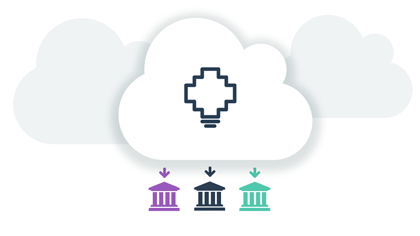
Using our Custom Services, organisations are able to embed Open Knowledge Maps services in their own discovery systems and provide AI-based, visual entry points to their holdings.
You can set individual parameters, including the ability to restrict knowledge maps to your own data sources. The Custom Services are available as cloud components, so there is no need to install new software on your servers.
The Custom Services can be used in a variety of ways. Below you find a selection of live case studies illustrating what an integration could look like. In Austria and Switzerland, catalogue integrations are available as modules via the national library networks OBVSG and SLSP. For more information, please see our presentation.
To use Custom Services in your organisation, please contact chairman Dr. Peter Kraker at: pkraker@openknowledgemaps.org
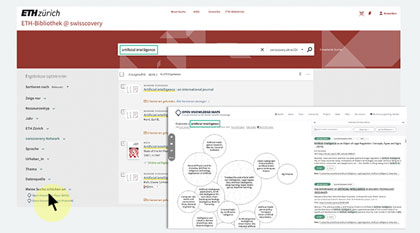
Are you looking for an effortless way of integrating our Custom Services? Look no further. The ETH uses our knowledge maps to complement their library catalogue search. The integration enables users to send their query to Open Knowledge Maps with a single click.

Would you like to provide AI-driven visual discovery for a large collection of data? Take a look at AUSSDA’s website that uses our services to enable exploring social science datasets. This example also shows you how to embed our entire service from search box to visualisation, avoiding the need for your own discovery system.

Are you in need of a tool that supports responsible evaluation? Then this one’s for you. VisConnect is a new service by Open Knowledge Maps that enables research assessment aligned with DORA and CoARA. This tool provides rich overviews of researchers that can also be used to represent the breadth and depth of your institutional output.
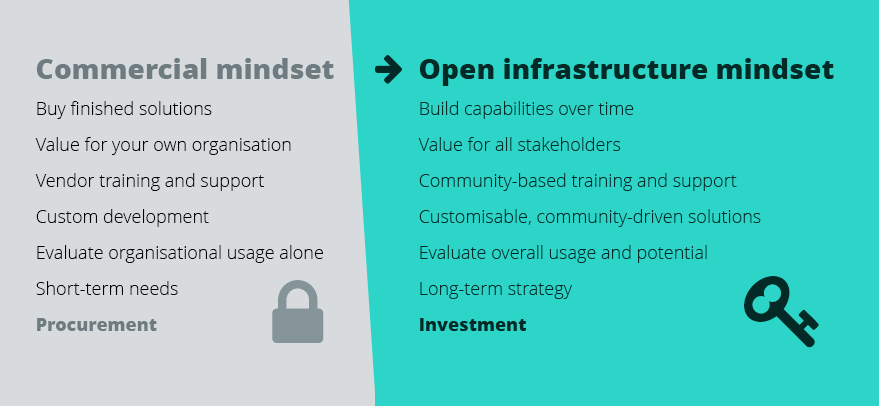
Open Knowledge Maps follows a fundamentally different approach from commercial research platforms. Instead of purchasing services from a vendor, supporting members collaboratively finance and govern shared infrastructure.
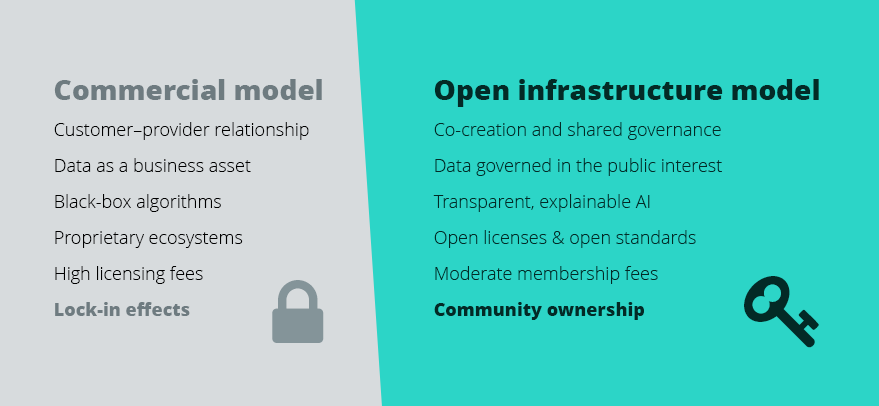
This open infrastructure model offers clear long-term benefits. However, it can only succeed if enough institutions become supporting members. This requires a significant shift in mindset: from procurement to investment.

Open infrastructure: Support the development and operation of free and openly licensed infrastructure that is developed in close collaboration with the community. Learn more about our approach to building digital infrastructure.

AI-driven research services: AI-driven search and discovery services that build on integrations with major data providers (BASE, ORCID, OpenAIRE, PubMed) and support new applications such as responsible research assessment.
Institutional integration: Integrations into library catalogues, repositories, and discovery systems via modular components and APIs tailored to institutional needs via the Custom Services.

Training and support: A wide range of training activities and materials, as well as technical documentation and support that foster onboarding, adoption and integration.
We currently offer supporting memberships in three categories. For more information on the categories, please see the details below. Note: Small organisations mean small and medium-sized enterprises (SMEs) as defined in the relevant national or regional classifications. An exception are infrastructure organisations and networked organisations, which are always considered to be large organisations.
As a supporting member, you are directly involved in the decision-making process around Open Knowledge Maps by way of the Board of Supporters. The Board of Supporters provides input on the technical roadmap and has one third of the vote on what features are implemented on Open Knowledge Maps. This is done in a lightweight process via two short web forms. It is up to the members to which extent they choose to engage with this process.
Discounts for consortia of 10 or more organisations are available! For more information please contact Open Knowledge Maps founder and chairman Dr. Peter Kraker at: pkraker@openknowledgemaps.org.
With your contribution, you facilitate the maintenance of Open Knowledge Maps. This makes sure that the platform will be available now and in the future.
With your contribution, you support the maintenance, but also the development of substantial new features on Open Knowledge Maps. This makes sure that we can improve Open Knowledge Maps going forward.

With your contribution, you support the future of research discovery where AI and visualisation go hand in hand to support exploration - but the user remains in control. This enables us to build open, transparent and responsible AI infrastructure that users can trust and understand.
1) Following a decision of the General Assembly in June 2026, membership fees are adjusted annually based on the Austrian Consumer Price Index (CPI) to reflect inflation and support the long-term sustainability of Open Knowledge Maps.
We joined Open Knowledge Maps as a Supporting Member because it is an innovative tool for literature search and we are eager to support the further development of Open Knowledge Maps.
Dr. David Johann, Head of Group Knowledge Management, ETH Library, ETH Zurich
Open Knowledge Maps is a considerable reinforcement in the areas of open science & open access, which are central to our research services.
Dr. Andrea Hacker, Open Access and Bern Open Publishing (BOP), University Library Bern
Open Knowledge Maps is one of these initiatives we consider to be a visionary innovator in the field of discovery in open spaces.
Prof. Dr. Klaus Tochtermann, Director, ZBW
We are delighted to announce our new partnership with Open Knowledge Maps. We share the common goal of enhancing the visibility of research results beyond disciplinary boundaries and thus contributing to knowledge generation.
Mag. Beate Guba, MSc., Library Director, TU Wien Bibliothek
As a longstanding innovator in digital librarianship, we are proud to support one of the most forward-thinking open infrastructures in scholarly communication.
Mag. Dr. Ulrike Krießmann, Head of Library and Archive, Graz University of Technology
We deem it absolutely critical to support innovative and visionary infrastructures such as arXiv, the DOAJ, OLH and now Open Knowledge Maps. We are delighted to be able to contribute to Open Knowledge Maps' sustainability, and, thusly, to its long-term independence.
HR Mag. Brigitte Kromp, Head of Central Library for Physics and Chemistry, Vienna University Library
We provide our scientists with the freedom to experiment and rethink, exploring experimental methods to make knowledge transfer more creative, flexible and effective. The LBG OIS Center, in particular, is an international centre for open and interdisciplinary research with a strong focus on participatory practices. We are proud to be a long-term supporting member of Open Knowledge Maps, and to work together on societal challenges and opportunities.
Mag. Dr. Georg Russegger, Head of the Open Innovation in Science Center at the Ludwig Boltzmann Society
As a truly open discovery tool, Open Knowledge Maps revolutionize the way scientific knowledge can be revealed.
Dr. Xenia van Edig, Senior Business Development, Copernicus Publications
On the one side the Open Science movement has increased the accessibility of academic knowledge, but on the other hand there is a discoverability crisis that in a lot of cases negatively affects Scholarly Communication. Open Knowledge Maps intends to close this gap and that's why it deserves to be supported with our best efforts.
Mag. MSc. Andreas Ferus, Interim Library Director, Academy of Fine Arts Vienna
Die Angewandte shares and supports the core principles of Open Knowledge Maps in particular with regards to open science, user-centred design, and open source.
Dr. Florian Bettel, Senior Scientist at the Department of Cultural Studies, die Angewandte
As a picture is worth a thousand words, the Open Knowledge Maps are probably the best way to discover new scientific knowledge. There is no way we could have missed such a great opportunity!
Laurent Gobat, Head of academic information and libraries, University of Neuchatel, Switzerland
The University of Lausanne considers knowledge to be a public good. It intends to make it available to society in order to address the major issues of our time in all their complexity. Open Knowledge Maps is the perfect opportunity to enhance the way we communicate and broadcast the knowledge generated at our institution with the world.
Dr. Micaela Crespo, Open Access Coordinator UNIL, Université de Lausanne, Switzerland
We're happy to join Open Knowledge Maps to give researchers and the interested public more possibilities to explore research results in a new, innovative way. Looking forward to sharing these possibilities in our new research platform based on DSpace soon.
Ruedi Lindegger, Group leader of Research Services, Vice President's Board Research & Faculty, University of St. Gallen
At the Austrian Library Network, we share Open Knowledge Maps’ commitment to support and empower researchers and library users in finding, exploring, discovering and structuring the most relevant sources for their work. As a cataloguing and discovery systems provider and central library network agency, we enable institutions and librarians in providing services required to achieve this shared goal. In this capacity, it is an honour to support Open Knowledge Maps in their mission to provide innovative and exciting ways of navigating research and sharing knowledge.
Mag. Wolfgang Hamedinger, Managing Director, Austrian Library Network and Service Ltd (OBVSG)
KU Leuven Libraries is devoted to stimulating the development of non-profit and community-led open science initiatives. We support a growing number of sustainable and equitable open scholarship infrastructures through the KU Leuven Fund for Fair Open Access. Our support of Open Knowledge Maps fits perfectly with this mission as we believe in the need for a non-profit approach to explore and discover scientific knowledge.
Laura Mesotten, Process Manager Research and Open Scholarship, KU Leuven Libraries
Paywalls may prove challenging when searching for scholarly publications. Yet another challenge is selecting a publication out of the thousands that may appear in the search results, especially for those outside of academia. Therefore, the KB, National Library of the Netherlands, is happy to officially support Open Knowledge Maps and is eager to explore how to better serve its community together with OKMaps.
Astrid van Wesenbeeck, Open Science Advisor, KB
The Gates Foundation is committed to information sharing and transparency. We believe that published research resulting from our funding should be promptly and broadly disseminated.
Ashley Farley, Program Officer, Knowledge & Research Services team, Gates Foundation
The societies’ primary purpose is to conduct biological and natural research, and to make this accessible to everyone through publication, education, and its museums. Today, its purpose is more important than ever, due to a global increase in both interest and curiosity which leaves many biological questions to be answered, such as those regarding climate change and the conservation of our planet. Therefore we are happy to support Open Knowledge Maps in order to jointly further strengthen the system of ‘Open Science’ in the future.
Prof. Dr. Klement Tockner, Director General, Senckenberg Gesellschaft für Naturforschung
We strive to give our researchers, and the teams who work alongside them, truly useful data and information about their open research outputs; we want them to be able to see this in a way which maximises its visual impact and could help them to identify future collaborative partners. Open Knowledge Maps provides the perfect platform for this, and their ethos and approach aligns with our own commitment to open research and bringing research to wider communities.
Bill Ayres, Strategic Lead for Research Data Management & Scott Taylor, Head of the Office for Open Research, The University of Manchester Library
As a promoter of all the university's strategic goals in research, teaching, continuous learning and open scientific communication, we share a commitment with Open Knowledge Maps to open science and transfer knowledge beyond academia.
Ari Muhonen, Library Director, University of Eastern Finland (UEF)
IT:U and Open Knowledge Maps are following a mutual mission: to provide, develop and widen scientific knowledge, which is the key to every solution. Knowledge makes the difference, and together we can shape the future!
Gabriele Költringer, EMBA, Chief Operation Officer, IT:U Interdisciplinary Transformation University Austria
Finding and evaluating research literature is central to scientific work. Our role as a university library is to provide tools and training for everyone at HU Berlin to achieve this. By supporting Open Knowledge Maps, we introduce an innovative tool into our portfolio, benefiting both students and researchers. We look forward to exploring new ways of discovering research!
Dr. Christina Riesenweber, Open Research Coordinator, University Library, Humboldt-Universität zu Berlin
We joined Open Knowledge Maps as a supporting member because BOKU is developing its own innovative research information system and Open Knowledge Maps helps us to better highlight and communicate research results.
Prof. Dr. Christian Obinger, Vice Rector for Research and Innovation, BOKU University
We strongly believe that open science is essential to ensure that research knowledge is adequately shared as the public good it ought to be. Moreover, visualizing search results the way Open Knowledge Maps does, allows researchers and the wider public to explore scientific outputs more intuitively and reveal connections between topics. We are very glad to support Open Knowledge Maps in making open science more accessible, transparent, and impactful.
Renate Pfann, Head of Library, University College of Teacher Education Vienna